
Galicia’s innovation ecosystem: organisations, infrastructure and business collaboration
Galicia has universities, research organisations, technology centres and support bodies with capabilities to develop new products, improve processes and bring knowledge to market.
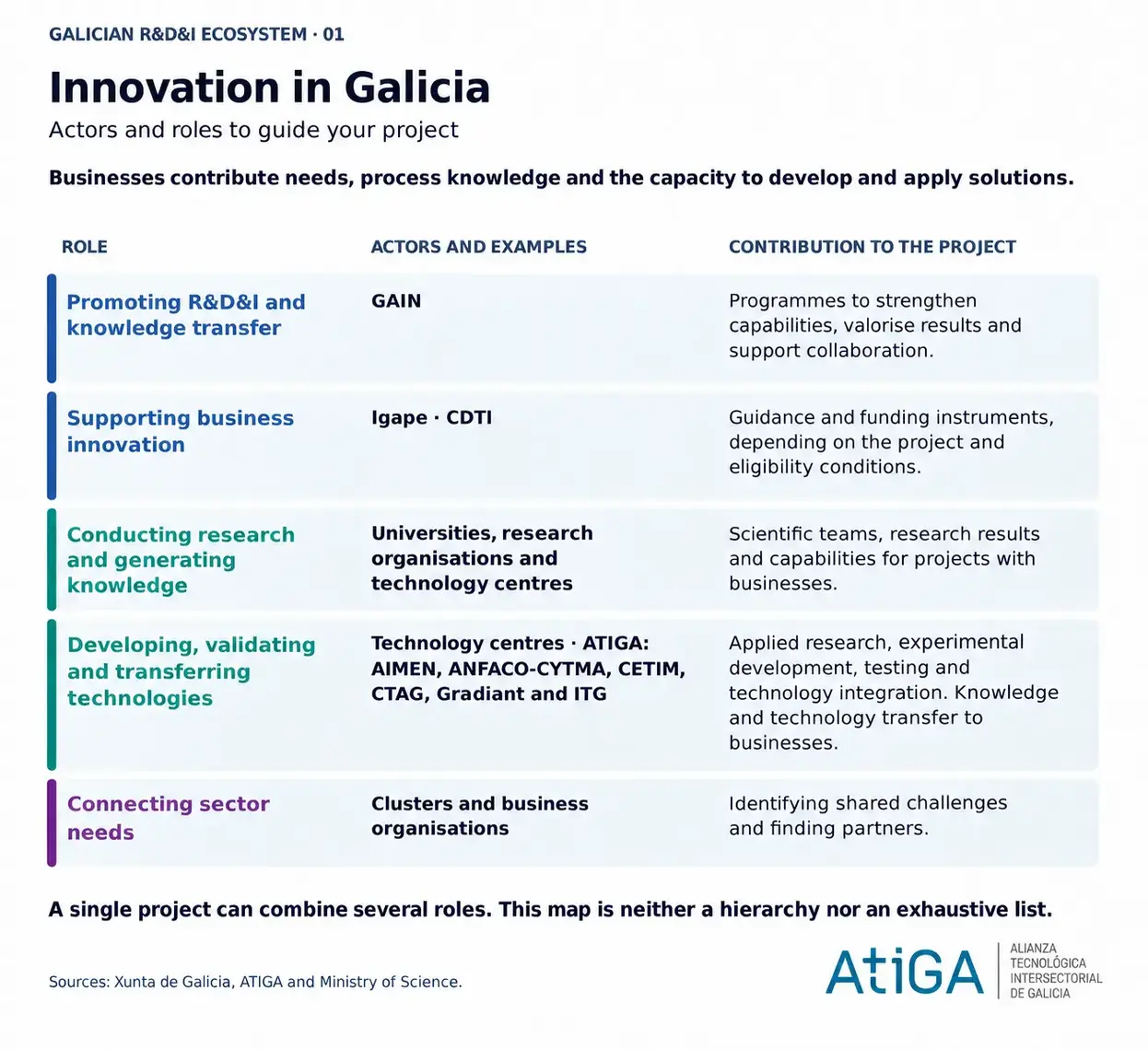
GAIN promotes research, innovation and knowledge transfer, while Igape strengthens support for business innovation. Understanding their roles and those of other organisations helps identify the right resources for each project.

[The information published in this article was updated on October 25, 2026, following the approval of the Galician Strategy for Business Innovation.]
One company needs to develop a material with better performance. Another wants to find a use for a by-product. A third wants to introduce a technology it has encountered through a research project but needs to establish whether it can adapt it to its operations.
All three can find support within Galicia’s innovation ecosystem. However, they need different capabilities: scientific knowledge, testing facilities, technology development, access to research results or funding.
Finding the right support requires understanding what each organisation contributes and how it can collaborate with others. Businesses also play an active part in this system: they conduct research, develop technologies, identify needs and provide the resources to turn a solution into productive activity.
A framework for connecting knowledge and industry
Innovation in Galicia is supported by several planning instruments. These include the RIS3 Galicia Smart Specialisation Strategy 2021–2027 and the Galician Research and Innovation Plan 2025–2027, approved as an operational planning instrument for that period.
For businesses, the Xunta de Galicia approved the Galician Business Innovation Strategy on 19 October 2026, with a horizon extending to 2028 and over €400 million. Under the slogan Galicia, a factory for innovation, it organises 14 measures around four pillars: activation, strengthening, structuring and connecting, and mobilising investment.
The strategy identifies collaboration between businesses and technology centres as a route for turning knowledge into industrial solutions. It includes existing instruments and new measures, access to which will depend on their implementation and the corresponding calls for applications.
For a company, this framework provides context on public priorities. The next step is to identify the knowledge, collaboration or resources needed to develop its project.
GAIN and the development of research and knowledge transfer capabilities
The Galician Innovation Agency — GAIN — is one of the main public bodies supporting Galicia’s R&D&I system. Its activities include research results valorisation, collaboration between organisations and the strengthening of scientific and technological capabilities.
Its role can be seen in specific instruments. Ignicia Proof of Concept supports the development of commercial applications for results generated by research organisations. Other measures support technology centres’ research and experimental infrastructure. Although their target beneficiaries and conditions differ, they help provide knowledge and facilities that can be applied in business and industry.
GAIN also works to strengthen knowledge transfer structures and professionals. Its collaboration with FEUGA includes support for valorisation, training and the professionalisation of this activity.
The GAIN website is the reference point for learning about these measures. The conditions and deadlines for each call should be checked through the Xunta’s electronic administration portal and the Official Gazette of Galicia.
Technology centres and ATIGA’s role as a central pillar of technology transfer
Technology centres combine applied research, experimental development and technological services. They can help explore alternatives, create solutions and carry out tests to assess performance.
ATIGA brings together AIMEN, ANFACO-CYTMA, CETIM, CTAG, Gradiant and ITG. Their capabilities cover fields such as advanced manufacturing, the food industry, materials, mobility, digital technologies, energy and sustainability.
A company may need to develop a manufacturing process, assess food preservation, investigate material recovery or integrate data and sensors into a facility. Identifying the right expertise and resources helps establish which centre can address each need.
Collaboration may also involve universities, other research organisations, technology suppliers and end-user companies. Their roles complement one another: the team’s composition should reflect the challenge and the work that remains.
The project case studies published on ATIGA’s website illustrate applications of these capabilities and offer possible starting points for new collaborations.
Igape and CDTI: support and funding for business innovation
Since 2024, the Galician Institute for Economic Promotion — Igape — has had a business innovation department focused on industry and strengthening Galicia’s business base, particularly SMEs. Its instruments address different needs: accessing specialist knowledge, developing products and processes, or introducing technologies into business operations.
Programmes such as Igape Innova, Industria Innova and IA360 reflect this variety. Their suitability depends on the planned work: an innovation plan, an R&D project and the application of artificial intelligence require different capabilities and resources. Igape’s innovation section provides information on its instruments and access to their governing rules.
At national level, the Centre for Technological Development and Innovation — CDTI — provides funding for business R&D, technology entrepreneurship and international cooperation. Its offering includes grants and partially repayable aid, with specific conditions for each instrument.
Some CDTI programmes are particularly relevant to technology transfer, supporting SMEs and mid-cap companies that contract R&D activities to knowledge-generating centres or collaborate with these organisations in designated priority technologies. This approach connects business funding with external scientific and technological capabilities.
Other instruments address different circumstances. NEOTEC, for example, supports new business projects undertaken by innovative companies whose strategy is based on developing their own technology.
For a Galician company, Igape and CDTI are reference points worth considering when preparing a project. The technology partner helps define and carry out the work; the funding body assesses its eligibility under the relevant instrument. Before submitting an application, companies should check eligible beneficiaries, eligible costs, deadlines, obligations and compatibility with other support. The existence of several funding routes does not mean they can be combined to finance the same activities.
Universities and research organisations
The universities of Santiago de Compostela, A Coruña and Vigo, alongside other research organisations and centres in Galicia, bring together teams, facilities and results that can help address business needs.
Knowledge transfer offices and units, and organisations such as FEUGA, facilitate connections between this research activity and its potential applications. They help identify results, manage their protection and structure agreements for their use. The Ministry of Science identifies these structures as links between knowledge-generating centres and the productive sector.
Clusters, business organisations and other resources for growth
Clusters and business organisations help connect companies, identify sector needs and promote joint initiatives. They can provide a starting point when a challenge affects several businesses or requires partners within a value chain.
The ecosystem also needs places where businesses can operate. Tecnópole, the Galicia Technology Park in Ourense, offers infrastructure and services for companies, entrepreneurs and projects linked to innovation and knowledge. Its role includes providing premises and resources to support business growth.
The Vigo Free Trade Zone Consortium, an economic development body, combines business parks with resources to support companies and entrepreneurs. These include the business initiative centres at A Granxa and Porto do Molle.
A company looking for premises should consider the available space, services, proximity to collaborators and opportunities for expansion. These conditions also affect its ability to develop and apply technology.
How to use this map in a project
Consider a company that wants to find a use for an industrial by-product. It may need a team to study its composition, a centre with facilities to test a treatment and another company interested in using the recovered material.
A cluster could help identify shared needs or potential users. A knowledge transfer organisation could facilitate access to an existing research result. Support bodies would provide a route to explore funding instruments, depending on the participants and the proposed activities.
This is an illustrative example: each project will require a different combination. To explore potential collaborators, Innovarede provides a directory of centres and organisations within Galicia’s innovation ecosystem.
Before making contact, it is worth clarifying what the company wants to improve, which information it already has and what it needs to find out. This starting point makes it easier to identify capabilities, agree responsibilities and find the support needed to develop the work.
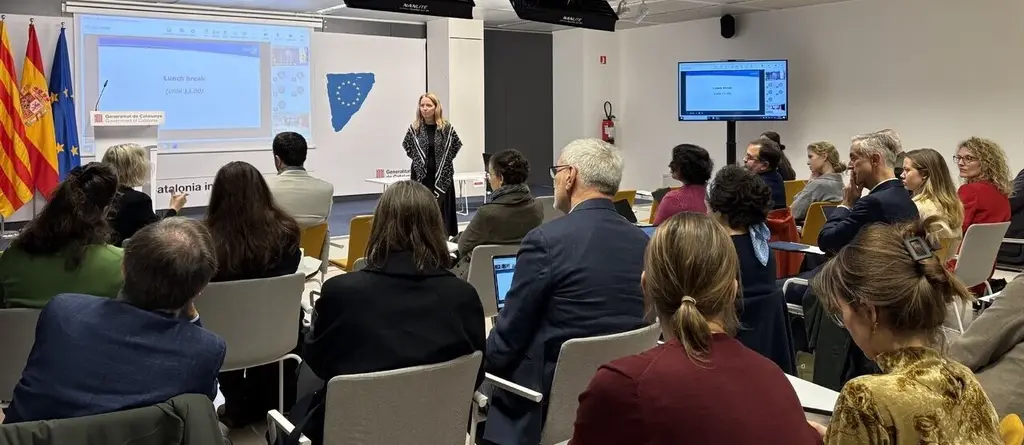
ATIGA examines the future of European R&I funding and opportunities for Galicia in Brussels
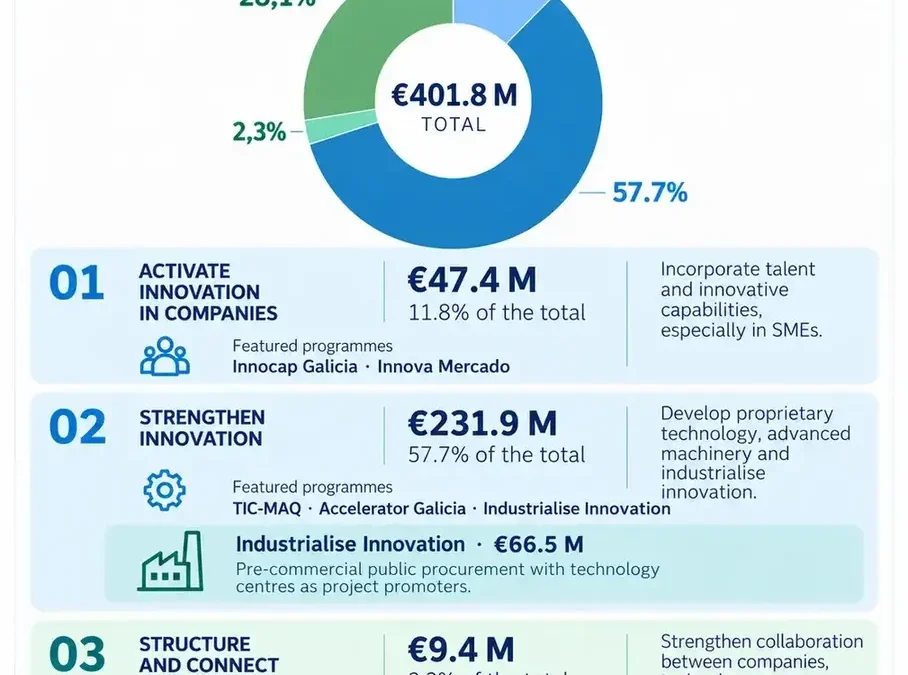
Galicia’s Innovation Strategy to Mobilise Over €400 Million to Bring Innovation into Galician Industry
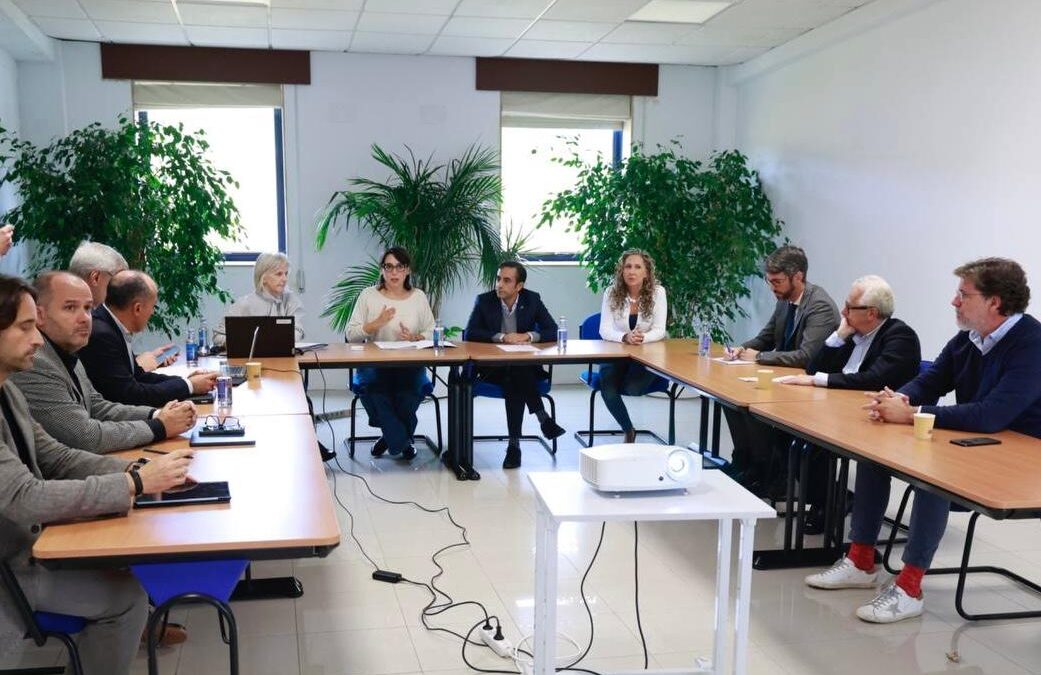
ATIGA meets with the Xunta to discuss the new strategy for industrialising innovation in Galicia
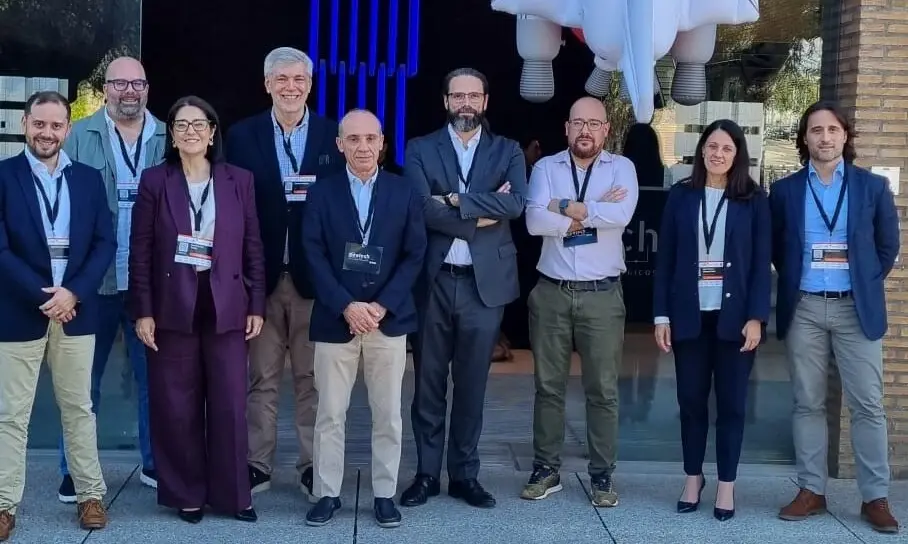
ATIGA at the forefront of Spain’s technological innovation at meetechSpain 2026

ATIGA strengthens its technological leadership after securing over €33 million for R&D&I in 2025

The ICT City of A Coruña is now a reality
Síguenos
